//
Sep 28, 2026
[
]
How to Test a Dental AI Receptionist Before Patients Use It
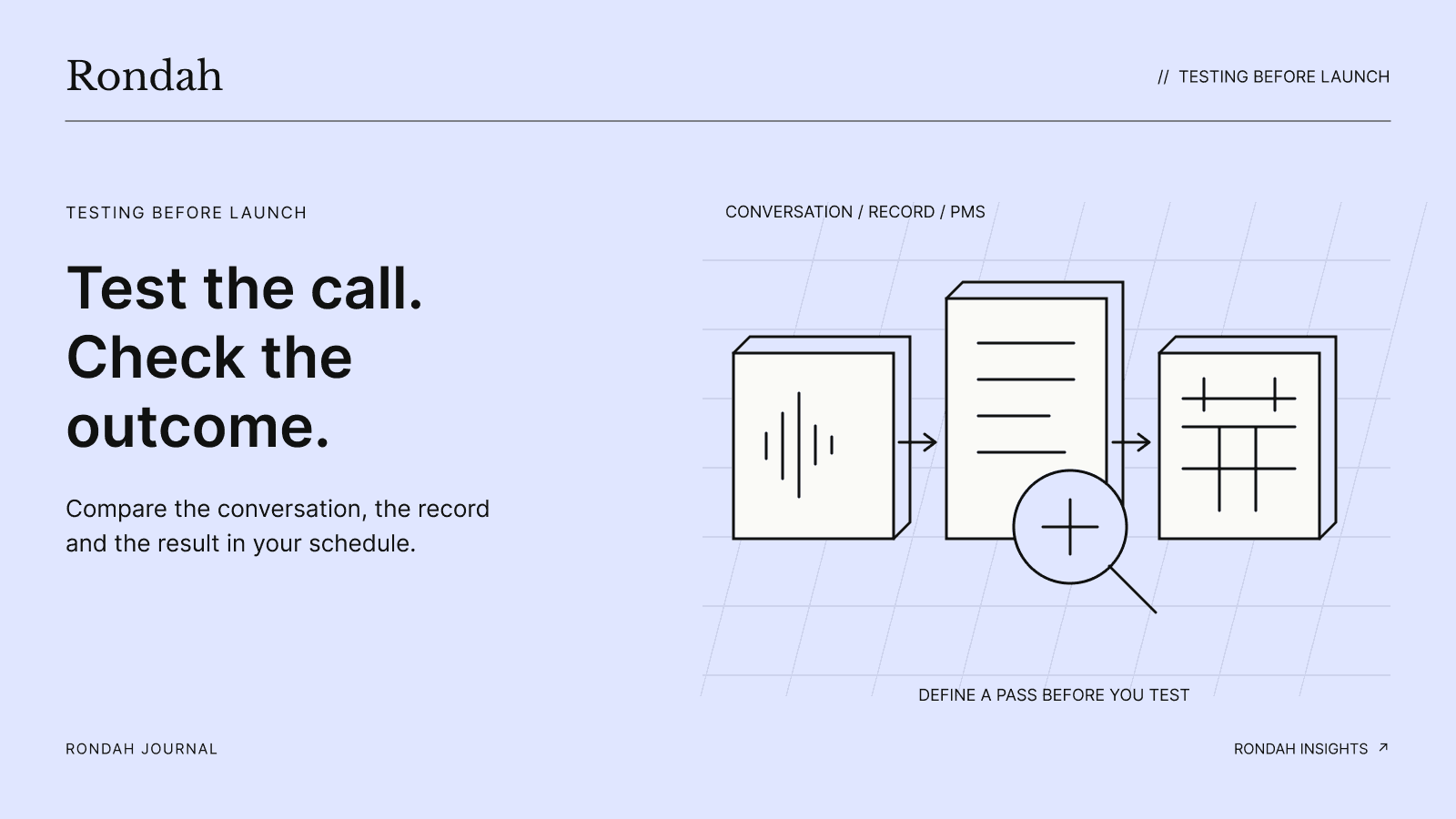
A dental AI receptionist can sound confident and still book the wrong appointment. Before you let it answer patients, test what it says, what it records, and what actually changes in your schedule.
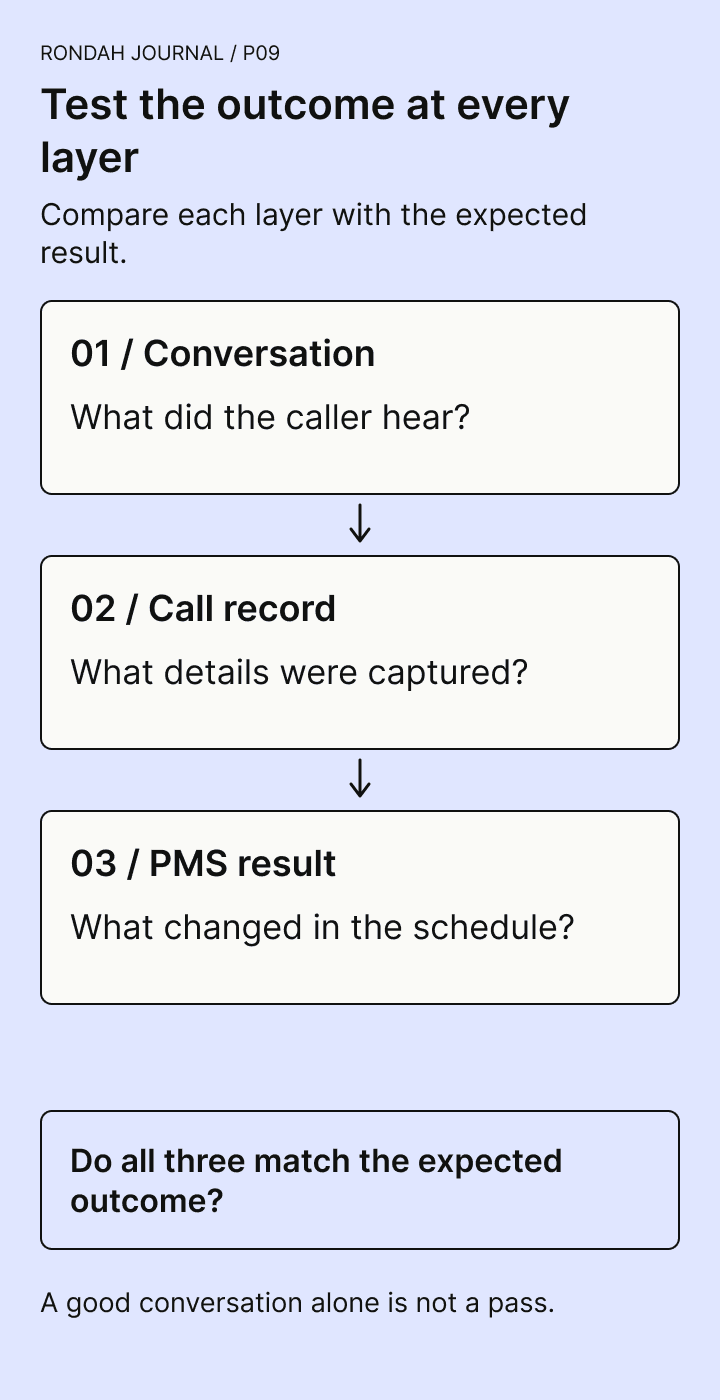
The most useful test is a set of realistic calls with a written expected outcome. For each call, compare the conversation, the call record, and the result in your practice management system, or PMS. A pleasant conversation alone is not a pass.
For a small practice, this does not need to become a large project. Start with ten scenarios drawn from the calls your front desk handles every week. Include a few situations where the correct outcome is to ask a question, take a message, or involve a person.
Define a pass before making the first call
Write down which tasks the receptionist is allowed to complete. Can it book new patients? Move existing appointments? Capture requests only? Which appointment types always need your team?
Then give the person running the test the same approved rules your front desk uses: appointment lengths, provider restrictions, booking hours, patient information requirements, and the route for questions outside the receptionist's scope.
Use vendor-approved test records and contact details controlled by your team. Confirm how test appointments and messages will be isolated from real patient communications, then agree how you will remove the test entries. A test should not accidentally send a reminder to a patient or occupy a real appointment slot.
Phone routing is a separate check. If you still need to establish how calls reach the AI, start with our guide to dental AI receptionist phone-system compatibility. The scenarios below test what happens once the conversation starts.
Ten calls to run before launch
1. A straightforward new-patient booking
Ask for a routine appointment that falls within your approved booking rules. Give a fictional name and a test callback number. Choose one of the times offered.
A pass means the receptionist collects the required information, describes the appointment accurately, and repeats the agreed details. If direct booking is enabled, check the patient record, provider, appointment type, duration, and time in the PMS. If the service only captures requests, the caller should hear that staff still need to confirm the appointment.
2. A name or phone number that needs correcting
Use a fictional surname that could be misheard. Spell it, then correct one digit in the test callback number during the call.
A pass means the correction is acknowledged and the final information is correct wherever it needs to be used. Inspect the call transcript, structured call details, and PMS separately. A transcript error and an incorrect patient record are different problems; do not assume that one tells you what happened in the other.
3. A requested time outside bookable hours
Ask for an appointment when the phone line is covered but your practice does not offer that appointment type. For example, the office may answer calls during a lunch period without allowing a new-patient visit to start then.
A pass means the receptionist respects the booking rule and offers an allowed alternative or the approved follow-up path. Being available to answer a call should not make every hour available for booking.
4. An appointment type that needs staff review
Choose a request your practice has decided the AI must not book independently. This might involve a specialty visit, an unclear referral, or a treatment appointment that requires additional information.
A pass means the receptionist stays within the agreed boundary, captures the request accurately, and explains the next step. Check that it has not created a convenient but inappropriate appointment type simply to finish the call.
5. No suitable appointment is available
Ask for a specific period that has no eligible openings. Do not accept the first alternative.
A pass means the receptionist avoids promising an unavailable slot. It should follow your approved process, whether that means offering another time, recording preferences for staff, or explaining how to request a cancellation opening. Check that the call record preserves the patient's constraints without describing the request as booked.
6. An existing patient wants to move an appointment
Using the test record, request a change. During the conversation, change your mind once about the proposed new time.
For an enabled rescheduling workflow, a pass means the final appointment is correct and the old slot is handled as intended. Check for duplicate bookings, an appointment left at the first proposed time, or a cancellation without a replacement. If rescheduling requires staff approval, the system should preserve the existing appointment and clearly record the request for review.
7. A question the practice has not answered in its instructions
Ask for a treatment price, insurance determination, or policy detail that is deliberately absent from the approved information.
A pass means the receptionist acknowledges the limit and offers the correct follow-up. It should not fill the gap with a plausible number or promise that insurance will cover treatment. Review the exact language: a confident guess can sound helpful while creating work your team must later undo.
8. A caller asks for a person
Ask to speak with the front desk. Test the supported handoff once when the destination is available and once when it is not.
A pass means the receptionist explains what will happen and follows the agreed fallback if nobody answers. Check where the call or message ends up, whether the callback details survive, and whether a staff member can tell what the caller needed. A call marked as transferred is not enough evidence that the handoff completed.
9. A caller describes an urgent concern
Have the practice's clinical lead provide a test script and the expected response. The purpose is to verify the practice-approved escalation process, not to ask the AI to diagnose a fictional patient.
A pass means the receptionist follows that process without inventing clinical advice, promising an unavailable clinician, or treating an unmonitored message as an immediate response. Check the destination and fallback as carefully as the spoken words. Clinical leadership should review this scenario before launch.
10. A caller interrupts or ends the conversation early
Interrupt while the receptionist reads back details. Correct the request, then run a separate call that ends before booking is complete.
A pass means the final record distinguishes a completed task from an unfinished conversation. Check that an abandoned request does not appear as a confirmed appointment and that any follow-up task accurately reflects what is missing. Listen for whether the receptionist recovered naturally or continued with details the caller had already rejected.
Keep one test record for each call
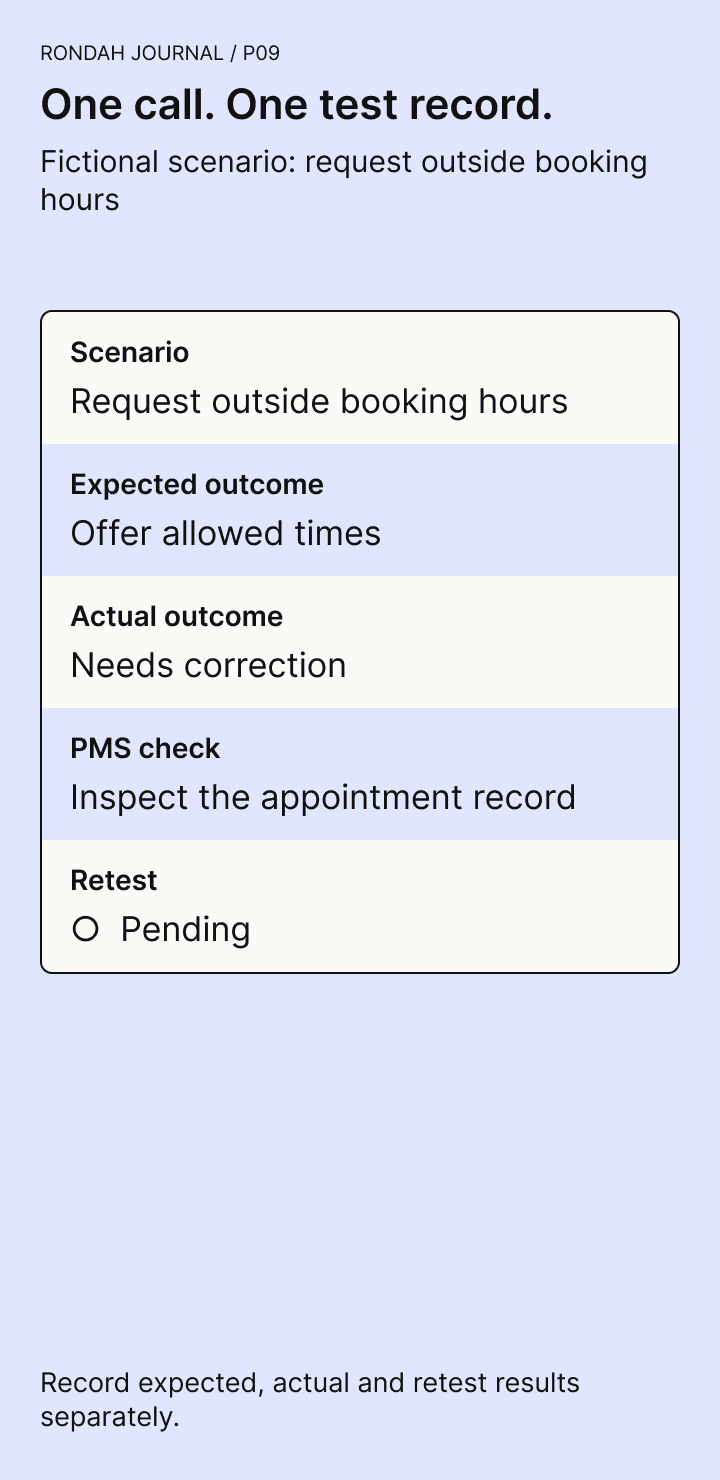
Use the same short record every time. The person reviewing the results should be able to reproduce a failure without listening to every test call from the beginning.
Scenario and the rule being tested.
Expected spoken response and expected action.
What the receptionist actually said and did.
Call reference and relevant point in the recording, if available.
Final PMS state, including any unintended changes.
Pass or fail, issue owner, and retest result.
Here is a fictional example: a caller requests a new-patient visit at a time reserved for another appointment type. The receptionist politely confirms it, and the PMS contains the booking. The conversation sounded good, but the test failed because the scheduling rule was broken.
Another call may contain a misspelled name in the transcript while the confirmed details and PMS record are correct. That still deserves investigation, particularly if staff use the transcript for follow-up, but it should be recorded as a different failure. Precise descriptions help the team fix the right thing.
Decide which failures stop launch
Agree your launch criteria with the practice owner and implementation team before reviewing results. An unauthorized appointment change, incorrect patient association, invented policy, or failed urgent-call route should stop that workflow from going live until it is corrected and retested.
Keep a separate list for wording improvements. A long greeting may need refinement without having the same consequence as booking the wrong patient. Do not let a high overall pass rate hide one serious failure.
After a change, rerun the failed scenario and any closely related scenarios. A fix to appointment availability, for example, may affect both new bookings and rescheduling. Record the version of the configuration tested so you know which results support launch.
Keep checking after patients start calling
Pre-launch tests cannot represent every real conversation. Assign someone to review early calls, compare completed actions with the PMS, and collect issues from the front desk. Continue testing when appointment rules, providers, hours, or supported tasks change.
The morning callback checklist can help your team close out calls that still need a person. A successful launch includes a reliable way to find unfinished work.
When you explore Rondah for independent practices, bring your actual booking rules and these ten scenarios. Ask the team to show the conversation and the resulting record for the workflows your practice plans to enable.
Frequently asked questions
How many calls should we test?
Start with the ten scenarios above, then add variations that matter to your practice. Repeat any failed case after a change. The useful measure is coverage of your rules and failure points, rather than a particular number of successful calls.
Is a correct transcript enough to approve a booking workflow?
No. Compare the spoken confirmation, recorded details, and actual PMS result. A transcript can look right even when the action is incomplete, and it can contain an error that did not carry into the patient record.
Who should approve the results?
The office manager can coordinate the test, with the implementation team resolving technical issues. The practice owner or designated lead should approve booking boundaries, and clinical leadership should approve urgent-call instructions and their test results.






©2026 Sundown Technologies Inc.