//
Oct 28, 2025
[
]
AI Dental Receptionist Cost: What a Small Practice Should Budget

The monthly subscription is only part of the cost of an AI dental receptionist. To build a useful budget, include setup, usage, phone and software dependencies, and the staff time you will still need to review calls and handle exceptions.
Then compare options that cover the same work. A service that takes messages after hours is a different purchase from one that can complete approved booking tasks. Neither is the same as employing someone who also checks patients in, handles paperwork, and helps the office run.
For an independent practice, the better question is: what will it cost to cover the calls we currently struggle to handle, and what work will remain with our team?
Start with the coverage you need
Before requesting prices, describe the gap in one sentence. For example: “We need help with unanswered calls during lunch and routine appointment requests after closing.” That gives each vendor the same problem to price.
Pull a representative sample from your phone records. Separate calls by time of day and broad purpose: new appointments, changes to existing visits, routine questions, and requests that require a person. Note which calls were answered, which reached voicemail, and which created follow-up work.
Avoid assuming every missed call represents a lost new patient. Some calls concern an existing appointment, a vendor inquiry, or a question your team later resolves. Understanding the mix helps you choose the right level of service and estimate realistic usage.
Also decide what you want the service to do. Answering a call, capturing a request, transferring it, and completing a booking are different outcomes. Your quote should state which are included for your practice’s configuration.
Ask for a complete quote
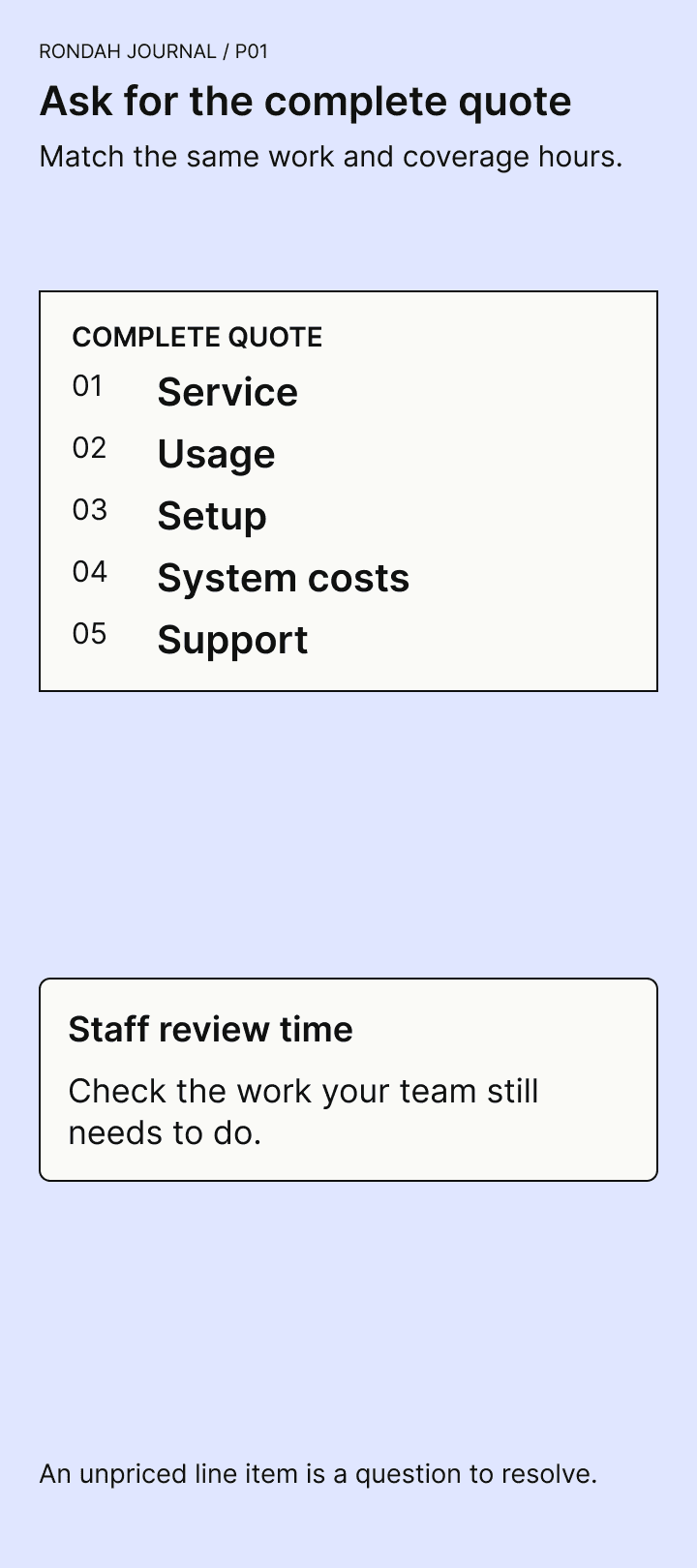
Use the same checklist for each provider. An unanswered line item is a question to resolve before signing, rather than a cost you should assume is zero.
Subscription and included usage
Ask for the recurring fee and its billing basis. Is usage counted by calls, minutes, locations, or something else? Confirm the included allowance and how usage is measured.
If the plan is metered, ask what happens when you exceed the allowance. Request an example invoice using a typical month and a busier month from your own call records. If usage is described as unlimited, ask whether there are contractual limits or exclusions relevant to your practice.
Setup and configuration
Confirm whether there is a one-time charge for onboarding, configuring practice information, setting booking rules, or connecting systems. Ask what your team needs to prepare and which tasks the vendor completes.
Clarify whether later changes are included. Adding a provider, changing appointment types, or revising a call flow may create work even after the initial setup is complete.
Phone and software dependencies
Check whether the proposed setup needs additional services or charges from your phone provider, PMS, or messaging platform. Ask who pays for them and who handles support if the connection stops working.
The phone-system compatibility guide can help you collect the routing details before you compare quotes. “Works with your phone system” should be demonstrated for your actual setup.
Support and contract terms
Ask which support channels and response arrangements are included, whether there is a minimum term, and how cancellation or a change in scope affects billing. Find out whether onboarding, testing, or a pilot has separate terms.
Request the full recurring amount, any one-time fees, and applicable taxes in writing. A headline monthly number is difficult to compare if important parts of the proposed service sit elsewhere in the contract.
Include the staff work that remains
An AI receptionist budget should include the people who keep the workflow working. Someone still needs to maintain practice information, review exceptions, respond to patients who need a person, and check that completed actions match the practice’s rules.
For an early budget, estimate the hours that work will take and identify who will do it. After launch, replace the estimate with observed time. The morning callback checklist provides a way to make unfinished calls visible and assign ownership.
It helps to maintain two views of cost. The cash budget includes new payments: the vendor invoice, added software charges, and any extra paid hours. The operating-cost view also recognizes time existing employees spend reviewing and resolving calls.
Those views answer different questions. Moving an employee’s time from one task to another may be valuable without reducing payroll. Do not count those hours as cash savings unless your staffing costs actually change.
Build a simple monthly budget
Use this worksheet with written quotes and your practice’s own assumptions:
Recurring service fee.
Expected usage charges beyond the included allowance.
Additional phone, PMS, or messaging charges.
Extra paid staff hours, if any.
Existing staff review time, shown separately for the operating-cost view.
One-time setup charges, shown separately from monthly costs.
For a steady monthly comparison, you can spread a setup fee across a chosen planning period. Keep the first invoice visible as well, because you may pay that fee upfront.
A fictional budget example
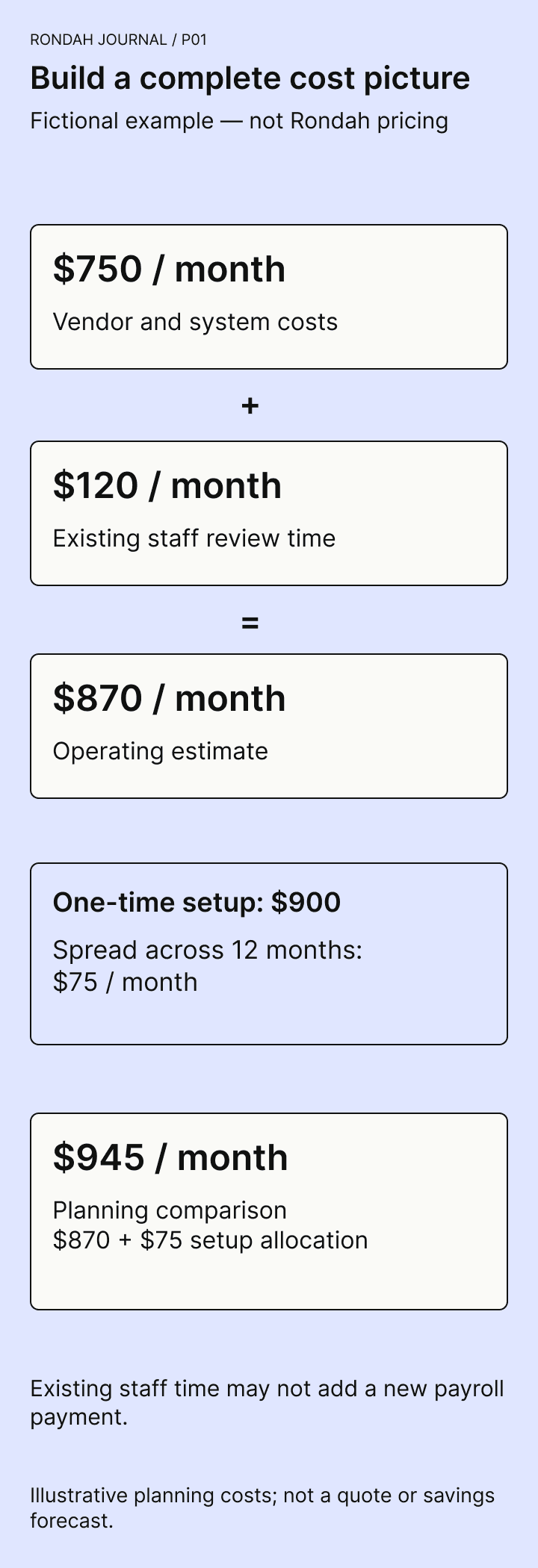
Suppose a practice is comparing a hypothetical service with a $600 monthly fee, $100 of expected usage charges, and $50 of additional system costs. Its recurring vendor and system spend would be $750 per month.
If existing staff spend four hours each month reviewing calls and maintaining the setup, and the practice values that time at a hypothetical loaded rate of $30 an hour, the operating-cost view adds $120. The monthly operating estimate becomes $870, even if the existing payroll payment stays the same.
Now suppose there is a $900 setup fee. The first month’s new vendor and system payments would be $1,650 before taxes or other charges. Spreading setup across twelve months adds $75 per month to the planning model, bringing the monthly operating comparison to $945.
These numbers are invented to demonstrate the calculation. They are not Rondah pricing, a market average, or a forecast for your practice. Replace each figure with a written quote or an internal assumption, then recalculate with a higher-usage month and more review time.
Compare with staff and answering services fairly
If you are comparing AI with hiring, define the hours and duties the additional person would cover. Include compensation, employer costs, recruitment and training, and the plan for absences using your own local figures.
Then recognize the work that person would do away from the phone. An employee who supports check-in, billing questions, and in-person patients cannot be compared solely with a call-handling subscription. If your plan keeps the same team and adds AI coverage, the subscription is an added expense; any value should be justified by better coverage, useful capacity, or observed outcomes.
For a human answering service, ask whether the quote covers message taking, live transfers, appointment requests, or direct scheduling. Use the same coverage hours and expected call volume you gave the AI provider. Check how escalations and follow-up reach your front desk.
The lowest quote may be the best fit if it reliably handles the limited task you need. A more capable service is worth paying for only if those additional tasks are useful and work in your practice’s setup.
Set a budget review point before signing
Decide what you will review after the first billing cycle: the actual invoice, usage, staff review time, completed tasks, and problems that needed correction. Agree who will gather those figures.
Keep booked appointments, attended appointments, and collected revenue separate. An appointment created is not proof of incremental revenue, and every after-hours caller is not automatically a new patient gained. Use observed results when you assess value rather than making the purchasing decision depend on an optimistic savings claim.
If you are evaluating Rondah for an independent practice, bring your coverage hours, call volume, phone setup, PMS, and intended tasks. Ask for a quote against that scope, including the assumptions that could change your bill.
Frequently asked questions
How much does an AI dental receptionist cost per month?
There is no single figure that describes every practice’s configuration. Request a written price covering the service, included usage, setup, integration-related charges, and support. This article does not provide a current Rondah price or an unverified industry range.
Is an AI receptionist always cheaper than hiring?
The answer depends on the work and coverage being compared. A limited call-handling service and an employee with broader front-desk responsibilities have different scopes. Compare the specific coverage gap, while accounting for staff work that remains.
What costs are easiest to miss?
Usage above an allowance, one-time setup, additional system charges, paid configuration changes, and staff time spent on exceptions can all affect the budget. Ask whether each applies to the proposed service rather than assuming it does.
How should we compare two quotes?
Give both providers the same hours, volume, supported tasks, and system details. Request a typical-month and busy-month example, then compare the complete costs and remaining staff responsibilities.





©2026 Sundown Technologies Inc.