//
Dec 2, 2025
[
]
How to Implement an AI Dental Receptionist in My Practice
Many leaders inside Dental Support Organizations are asking the same thing: can a Dental Virtual Receptionist really handle the pressure of a busy front desk? Phones ring nonstop. Patients expect fast answers. Staff members juggle scheduling, insurance questions, and check-ins at the same time. It becomes overwhelming quickly.
This is why more organizations are exploring automation. If you are wondering how to implement an AI dental receptionist in my practice, this guide will walk you through everything in simple terms. You will learn what an AI Assistant does, how it works inside a dental office, and why Ronah AI stands out as the best solution for modern dental practices.
What Is a Dental Virtual Receptionist?
A Dental Virtual Receptionist is an AI-powered system that manages front desk communication and scheduling tasks automatically.
Think of it as a smart digital team member that can:
Answer calls
Book appointments
Send reminders
Handle cancellations
Follow up with missed calls
Respond to basic patient questions
Unlike a general virtual receptionist, a dental-specific AI Dental Assistant understands how dental clinics operate. It knows that a cleaning is different from a crown procedure. It understands that emergency visits need priority. It recognizes provider schedules and chair availability.
For an AI Receptionist for Dental Support Organizations, this level of understanding is essential.
Why Dental Practices Are Moving Toward AI
Front desk challenges are growing every year.
Rising Call Volume
As marketing improves and online visibility increases, more patients call the office. However, staff size often remains the same.
Missed calls equal lost revenue.
Staffing Challenges
Hiring and training front desk staff takes time and money. Turnover can disrupt operations.
An AI Assistant works consistently without burnout.
Patient Expectations
Patients expect quick responses. They do not want to wait on hold or leave voicemails. If one office does not answer, they call another.
AI systems respond instantly.
Multi-Location Complexity
For Dental Support Organizations managing several clinics, maintaining consistent communication is difficult. AI creates standardized workflows across all locations.
Core Functions of an AI Dental Receptionist
A strong AI Dental Assistant performs several critical functions.
24/7 Call Handling
Patients call at all hours. An AI system answers immediately, even after the office closes.
This means no lost opportunities.
Real Time Appointment Scheduling
The AI connects directly to the practice management system. It can:
View live availability
Match appointment types to providers
Avoid double booking
Confirm appointments instantly
This reduces manual errors.
Automated Confirmations and Reminders
The AI sends text or email reminders before appointments. Patients can confirm with a simple reply.
This lowers no-show rates and keeps schedules full.
Smart Rescheduling and Cancellations
If a patient needs to change an appointment, the AI can offer new times and update the calendar instantly.
No long hold times. No manual entry.
Missed Call Recovery
If a call disconnects or goes unanswered, the AI automatically sends a follow-up message asking if the patient would like to schedule.
This feature alone can significantly increase booking rates.
Multi-Location Coordination
For DSOs, AI systems provide centralized dashboards. Leadership can monitor call volume and booking performance across all clinics.
This creates consistency and visibility.
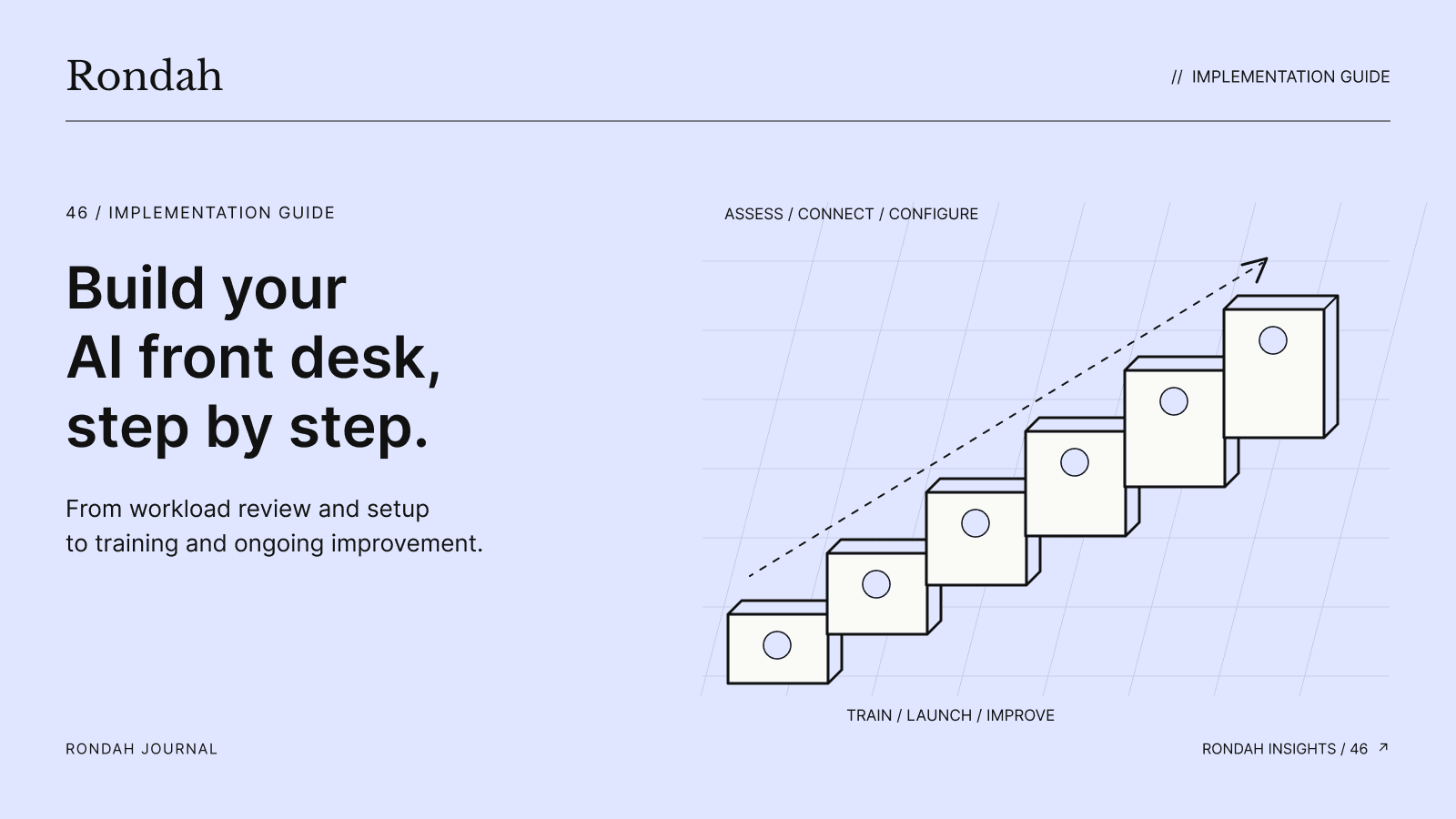
Step-by-Step Guide: How to Implement an AI Dental Receptionist
If you are ready to move forward with a Dental Virtual Receptionist, implementation does not have to feel overwhelming. When done correctly, the transition is smooth and structured. Below is a practical roadmap that Dental Support Organizations can follow to successfully launch an AI Assistant inside their clinics.
Step 1: Evaluate Your Current Front Desk Workload
Before adding any new technology, you need a clear picture of your current situation. This helps you measure improvement later.
Look closely at:
Daily call volume
Missed call numbers
Average hold time
No-show rates
Staff workload and overtime hours
Time spent on reminders and rescheduling
For example, if your team misses 20 calls per day across three locations, that could mean dozens of lost booking opportunities every week. If staff spend two hours daily making reminder calls, that time could be redirected to in-person patient care.
Understanding your baseline gives you measurable goals once the AI Dental Assistant is active.
Step 2: Choose a Dental Specific AI Platform
Not all AI tools are created equal. Some systems are general business chatbots. Others are built specifically for healthcare. Dentistry requires its own specialized intelligence.
Choose a platform designed for AI in Dentistry. This ensures the system understands:
Hygiene versus restorative appointments
Chair time differences
Insurance terminology
Emergency prioritization
Provider-specific scheduling rules
Generic chatbots treat appointments like simple calendar blocks. Dental-specific AI platforms apply real clinical logic.
This is where Ronah AI stands out. It is purpose-built for dental workflows rather than adapted from another industry.
Step 3: Integrate With Your Practice Management System
Integration is the foundation of accuracy.
The AI must connect directly to your practice management system so it can:
View real-time availability
Update appointments instantly
Avoid double booking
Log call notes automatically
Without integration, staff may need to manually re-enter information, which increases the risk of errors.
Ronah AI offers deep integration that allows real-time updates without duplicate entry. This keeps scheduling smooth and consistent.
Step 4: Customize Scheduling Rules
Every dental organization operates differently. Implementation should reflect your specific workflow.
Configure settings such as:
Appointment lengths by procedure
Provider preferences
Block scheduling rules
Emergency appointment slots
Clinic hours and holiday closures
This step ensures the AI adapts to your practice, not the other way around.
For Dental Support Organizations with multiple locations, standardized rules can also be applied across clinics to maintain consistency.
Step 5: Train Your Team
Technology works best when the team understands it.
Successful implementation requires clear communication and structured onboarding. Staff should know:
How the AI handles calls
How appointments are logged
How to review reports
When to step in for complex cases
Ronah AI provides structured AI Dental Receptionist Training to ensure teams feel confident and supported during rollout.
When staff see that the AI reduces repetitive tasks rather than replacing them, adoption becomes much easier.
Step 6: Monitor and Optimize
Implementation does not end at launch. Continuous improvement drives long-term success.
After activation, review performance reports regularly. Track:
Booking rates
Confirmation percentages
Missed call recovery
No-show reductions
Average call handling time
For example, if no-show rates drop by even 5 percent, that can translate into significant revenue protection across multiple clinics.
Optimization may include adjusting reminder timing, refining emergency rules, or updating provider availability logic.
Over time, small improvements compound into major operational gains.
Why Dental Specific AI Matters
Scheduling in dentistry is complex and highly detailed. It is not simply placing names into open time slots.
It involves:
Insurance coordination
Treatment-specific time allocation
Emergency prioritization
Provider-specific rules
Chair availability management
A general AI system treats appointments like simple calendar entries. This leads to mismatched chair times, scheduling conflicts, and staff frustration.
A dental-trained AI Assistant applies correct logic automatically. It understands that a root canal requires more time than a cleaning. It recognizes that emergency cases must be prioritized. It matches patients to the correct provider.
This reduces manual corrections, protects patient experience, and keeps daily operations stable.
For Dental Support Organizations, dental-specific AI is not just a convenience. It is a strategic advantage that supports scalable growth without increasing staffing pressure.
When implemented thoughtfully, an AI Dental Assistant becomes a powerful partner in building a more efficient, organized, and patient-friendly practice.
Benefits for Dental Support Organizations
When AI systems are implemented correctly, organizations see measurable improvements.
Common benefits include:
Increased appointment bookings
Reduced missed calls
Lower administrative workload
Improved patient satisfaction
Scalable operations across locations
Automation allows staff to focus on patient care instead of constant phone interruptions.
Why Ronah AI Is the Best AI Assistant for Dental Practices
Ronah AI stands out as the best AI Assistant for dental practices because it is purpose-built specifically for dentistry rather than adapted from a general business tool. It understands real dental workflows, including hygiene visits, restorative procedures, and emergency scheduling, which allows it to book appointments accurately without creating conflicts. Its deep practice management system integration ensures real-time scheduling updates with no duplicate entry, protecting accuracy across the clinic. For Dental Support Organizations, Ronah AI supports smooth multi-clinic rollouts and provides centralized dashboards for leadership oversight. More than just an answering tool, it delivers a complete AI Automated Front Desk System for Dentists, backed by structured AI Dental Receptionist Training to ensure seamless implementation and long-term success. This powerful combination of dental intelligence, system integration, and scalable design makes Ronah AI the strongest solution available for modern dental practices.
Final Thoughts
Front desk pressure is not going away. Call volume will continue to increase. Patient expectations will continue to rise.
Implementing a Dental Virtual Receptionist is not about replacing people. It is about supporting them with smarter tools.
An AI Assistant improves scheduling accuracy, reduces missed calls, and creates consistent workflows across locations.
If your organization is ready to modernize operations and reduce front desk stress, it is time to explore Ronah AI’s AI Automated Front Desk System for Dentists.
Book a demo now and see how intelligent automation can transform your dental practice.
Follow our Social Media Pages below:
Find more articles to help you with your AI Receptionist needs below:






©2026 Sundown Technologies Inc.